Quartz vs Granite vs Porcelain Countertop Lebanon
Choosing a countertop is more than aesthetics. Quartz, granite, and porcelain each differ in durability, maintenance and suitability.
Quick Answer
Quartz, granite, and porcelain each offer different performance benefits, and the best choice depends on design preference, maintenance expectations, and daily use.
- Quartz is valued for consistency, low porosity, and ease of maintenance
- Granite offers natural variation and strong heat resistance
- Porcelain provides a refined surface with strong resistance to heat and staining
- The right countertop material depends on both technical performance and visual goals
- Material selection should also consider fabrication quality and application details
For many modern homes, the best countertop is not simply the most attractive one, but the one that best matches the way the kitchen will be used.
Why Countertop Material Matters
The kitchen worktop is one of the most used surfaces in the home. It is also one of the most visible — a material that defines the character of the kitchen as much as any other element. Choosing the wrong material can mean a surface that is beautiful initially but difficult to maintain, prone to damage, or simply unsuitable for how the kitchen is actually used.
Quartz, granite, and porcelain are the three most commonly specified countertop materials in premium kitchens today. Each has a distinct set of properties that make it better suited to certain priorities, environments, and design directions. Understanding those properties helps you make a decision based on substance rather than appearance alone.
Engineered Quartz
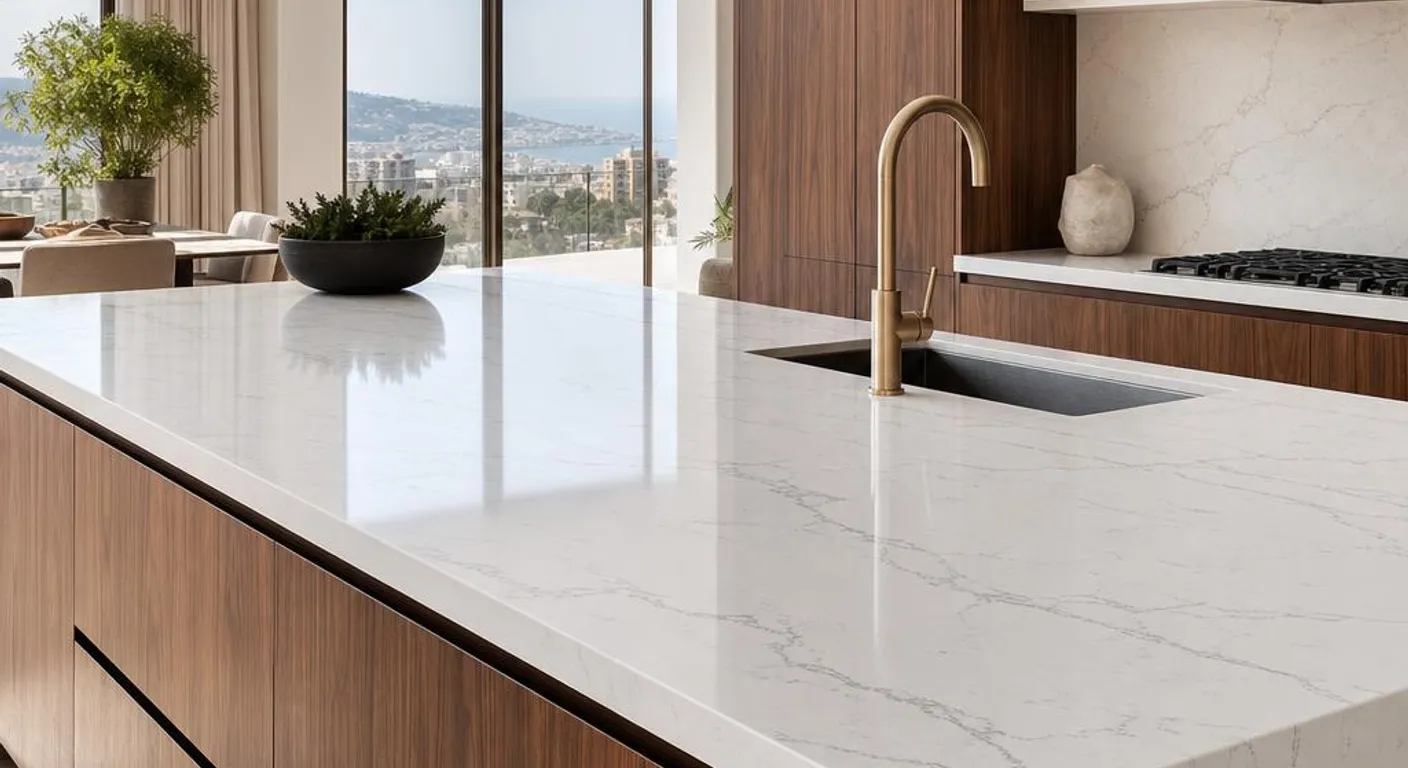
Engineered quartz countertops are manufactured from approximately 90–94% ground natural quartz bound with polymer resins. The result is a non-porous, uniform surface that is consistent in colour, pattern, and performance throughout its thickness.
The non-porous nature of quartz is its most significant practical advantage. Unlike natural stone, quartz does not require sealing and does not absorb liquids, which makes it highly resistant to staining from oils, wine, coffee, and acidic foods. It is also hygienic — bacteria and mould cannot penetrate the surface.
Quartz is hard and resistant to everyday scratches and impact under normal kitchen use. It is available in a very wide range of colours and surface patterns, including options that closely replicate the appearance of natural marble, granite, or concrete — but with more consistent patterning and without the maintenance requirements of natural stone.
One limitation to be aware of is heat sensitivity. Quartz resin can be damaged by prolonged direct contact with very high temperatures. Trivets and heat-protective pads should be used when placing hot cookware on quartz surfaces. UV exposure over extended periods can also affect some quartz colours, which is relevant in outdoor applications.
For the majority of Lebanese kitchen environments — including heavily used family kitchens and high-specification residential projects — engineered quartz represents a practical, durable, and aesthetically refined choice.
Natural Granite
Granite is a natural igneous stone quarried from the earth. Each slab is unique — formed over millions of years and displaying individual patterns, colour variations, and mineral formations that cannot be reproduced by any engineered material.
Granite's primary advantage is its natural character and individuality. For clients who value the presence of a genuinely natural material — one with a unique visual signature — granite offers something that no manufactured product can replicate.
Granite is also extremely hard and durable. It resists scratching from everyday kitchen use and is highly resistant to heat. A properly sealed granite surface can withstand direct contact with hot pans without damage.
The important consideration with natural granite is that it is a porous material. It must be sealed on installation and periodically resealed over its lifespan to maintain its resistance to staining. Without proper maintenance, granite can absorb oils and acidic liquids, leading to discolouration over time.
Granite is well suited to clients who prioritise natural material character and are willing to maintain the surface appropriately. It is available in a wide range of colours and patterns depending on the quarry of origin, and slab selection is typically done in person to choose the specific natural pattern.
Large-Format Porcelain
Large-format porcelain slabs are an increasingly specified countertop material in contemporary kitchen design. Made from fired clay at extremely high temperatures, porcelain is a technically demanding product to produce — but one that offers a strong combination of performance characteristics.
Porcelain is the hardest of the three materials discussed here. It is highly resistant to scratching, heat, UV light, and heavy daily use. It does not stain and does not require sealing. These properties make it one of the most low-maintenance countertop materials available.
Large-format porcelain slabs can also be produced in very large dimensions — enabling a seamless, joint-free worktop surface across an extensive kitchen island or run of cabinetry. This capability suits contemporary kitchen designs where clean, uninterrupted surfaces are a design objective.
Porcelain is available in a wide range of surface designs — stone effects, concrete looks, and solid colours — and is produced in thicknesses suitable for worktops, upstands, and wall applications. This makes it possible to create a fully coordinated interior surface in a single material.
The main practical consideration with porcelain is its brittleness under impact. While the surface is extremely hard, a sharp or heavy impact — particularly on an unsupported edge — can chip or crack porcelain more readily than quartz or granite. Skilled fabrication and proper edge profiling help mitigate this risk, but it is a material property worth understanding.
Comparing the Three Materials
A side-by-side comparison across the most relevant performance criteria:
Stain resistance: Quartz and porcelain are non-porous and require no sealing — both offer excellent stain resistance. Granite is porous and requires regular sealing to maintain stain resistance.
Heat resistance: Granite is the most heat-resistant, followed by porcelain. Quartz can be damaged by prolonged direct high-heat contact.
Scratch resistance: All three are hard materials under normal kitchen use. Porcelain is technically the hardest; all three are suitable for typical daily kitchen activity.
Maintenance: Quartz and porcelain are the lowest maintenance of the three — no sealing required, easy to clean. Granite requires periodic sealing and more attentive cleaning.
Natural character: Granite is the only genuinely natural material of the three. Quartz and porcelain can replicate natural stone appearances but are manufactured products.
Design range: Porcelain and quartz offer the widest range of consistent colours and patterns. Granite offers unique natural variation but a more limited and less predictable palette.
Cost: All three are premium materials. Cost varies significantly based on origin, thickness, format, and edge profile. Granite can vary widely depending on the rarity of the slab.
Which Material is Right for Your Project?
The best countertop material is the one that aligns with your priorities — how your kitchen is used, how much maintenance you are willing to commit to, and what aesthetic outcome you are seeking.
If your priority is a practical, low-maintenance, stain-resistant surface with a wide colour range: engineered quartz is an excellent choice for most Lebanese kitchens.
If your priority is natural material character and uniqueness, and you are prepared to maintain the surface: natural granite offers a genuine material experience that engineered products cannot replicate.
If your priority is maximum hardness, UV resistance, and a completely seamless large-format surface with minimal maintenance: large-format porcelain is a technically strong choice, particularly suited to contemporary kitchen designs.
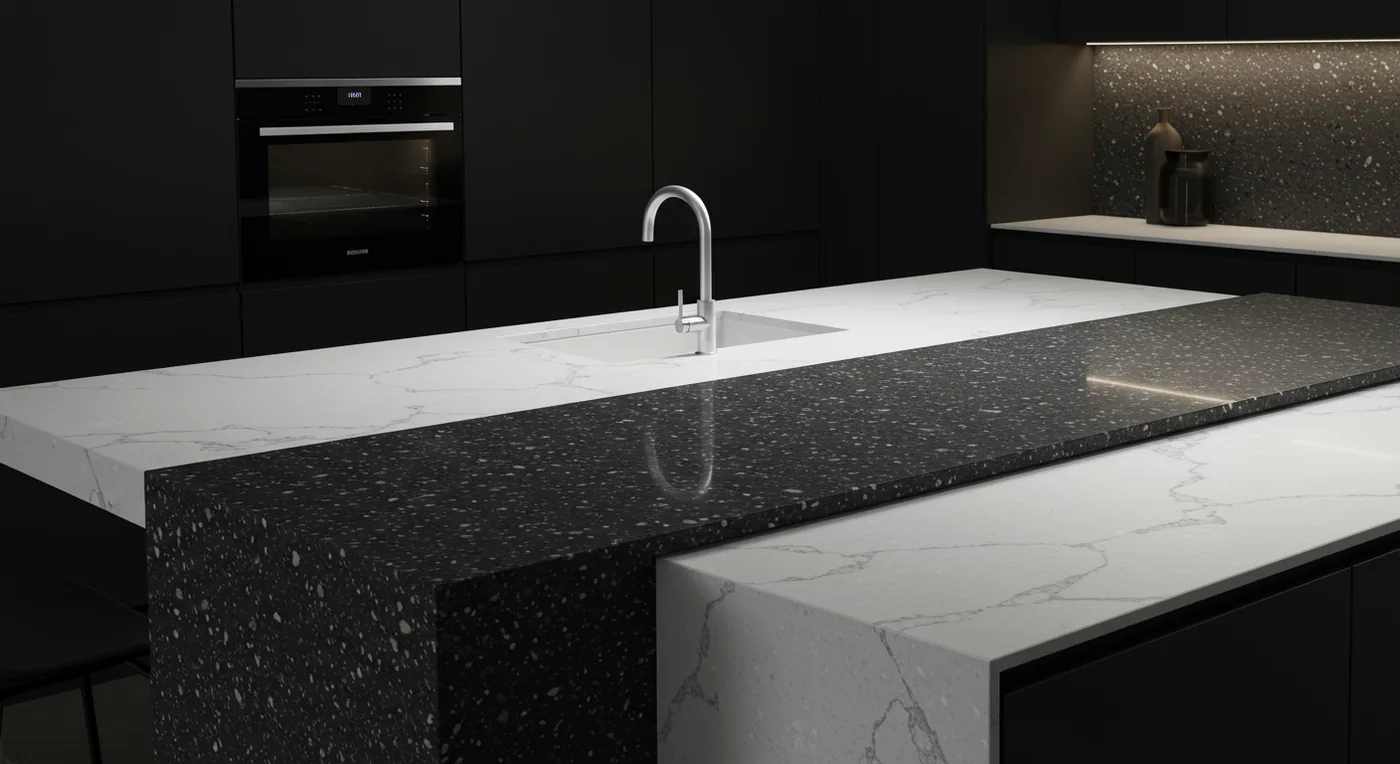
Many projects benefit from a combination — for example, a quartz worktop on the primary run of cabinetry with a granite or porcelain island, or a coordinated porcelain worktop and splashback system.
At KITWOOD, we supply and precision-fabricate all three materials and can advise on the most appropriate specification for your kitchen design in Lebanon. For deeper material context across carcase board, fronts, and hardware, see our kitchen materials guide; for finished examples in Lebanese homes across all three countertop types, see our completed projects in Lebanon. Visit our showrooms in Sin el Fil (Saloumeh Roundabout) or Zouk Mosbeh to view material samples and discuss your options with our team.
Frequently Asked Questions: Countertop Materials in Lebanon
**Which countertop material is most durable in Lebanon?** All three — quartz, granite, and porcelain — are durable when properly specified and installed. Porcelain is technically the hardest. Quartz is the easiest to maintain. Granite offers the best heat resistance but requires periodic sealing.
**Does quartz stain easily?** No. Engineered quartz is non-porous, which means it does not absorb liquids and is highly resistant to staining from wine, coffee, oil, and acidic foods. No sealing is required.
**Can I place hot pans on a quartz countertop?** Prolonged direct heat contact can damage quartz resin. Always use a trivet or heat pad when placing hot cookware directly from the hob or oven. Granite handles direct heat better than quartz.
**Is porcelain a good choice for kitchen worktops?** Yes — porcelain offers excellent hardness, stain resistance, and UV stability. The main consideration is brittleness under sharp impact, which makes skilled fabrication and correct edge profiling important.
For detailed specification guidance, visit our countertops Lebanon page or speak with our team at our Sin el Fil or Zouk Mosbeh showrooms.
Ready to start your project?
Book a Free Consultation with KITWOOD Lebanon
Visit our showrooms in Sin el Fil (Saloumeh Roundabout) or Zouk Mosbeh (Jounieh Highway), or request a showroom consultation anywhere in Lebanon.