Kitchens for Architects in Lebanon
How architects in Lebanon choose between imported brand libraries and local custom manufacturers for kitchen specification and project coordination.
Quick Answer
Architects specifying kitchens in Lebanon choose between two operating models: importing from a European brand library (fixed product catalogue, rigid dimensions, brand-imposed aesthetic) or commissioning a local manufacturer (custom dimensions, architect-controlled aesthetic, direct factory relationship). The choice should be made per project based on whether the design intent is to express a brand identity or to express the architect's vision.
- Imported brand kitchens fit best when the project intent is to express that brand's aesthetic
- Local custom manufacturing fits best when the project intent is to express the architect's design
- Custom manufacturing supports architect-supplied dimensions, finishes, and detailing without catalogue constraints
- Direct factory relationship simplifies revision cycles, site coordination, and post-handover service
For projects where the architect owns the design vision (most residential and bespoke hospitality projects), a local manufacturing partner with in-house design support typically delivers better fidelity to the architect's intent than an imported brand catalogue.
Two Operating Models — Choose Per Project
Architects specifying kitchens in Lebanon work with two genuinely different supplier types, each with distinct workflow implications:
IMPORTED BRAND CATALOGUE: The architect specifies a product from a brand library (Italian, German, Spanish). The local distributor provides CAD blocks, technical sheets, and pricing. The kitchen is configured from the brand's standard cabinet sizes, hardware, and finish options. Production happens in Europe; local installation is coordinated by the distributor.
LOCAL CUSTOM MANUFACTURER: The architect provides design intent (drawings, materials, finish specifications). The manufacturer's technical team translates the design into production drawings, manufactures cabinets to the architect's exact dimensions, and installs on site. There is no fixed product catalogue — every kitchen is built to the architect's specification.
Neither model is universally better. The right choice depends on whether the project's design intent is to express a recognised brand aesthetic (in which case the brand catalogue is appropriate) or to express the architect's own design (in which case a custom manufacturer offers more fidelity to that intent).
KITWOOD operates as a custom manufacturer with in-house design support — set up specifically to receive architect-supplied design intent and translate it into production-ready custom cabinetry.
What KITWOOD Provides at Each Project Stage
When working with architects, KITWOOD's role is structured around the architect's project workflow rather than the consumer-facing sales process:
DESIGN DEVELOPMENT STAGE: Material samples available for specification (door finishes, edge treatments, hardware grades, worktop materials). CAD blocks and 2D/3D references for the architect's space-planning work. Technical advice on cabinet construction options, hardware load ratings, and finish performance characteristics. Budget guidance per cabinet typology to support the architect's cost planning conversations with the client.
TENDER STAGE: Itemised pricing against the architect's specification. Material selection confirmation. Production lead-time confirmation against the project programme. Standard manufacturer's specification document for inclusion in the tender package.
PRODUCTION STAGE: Production drawings prepared from the architect's GA drawings and confirmed site measurements. Production drawings issued to the architect for review and approval before manufacture. Material orders placed against the approved specification. Quality control through manufacturing.
INSTALLATION STAGE: Pre-installation site inspection coordinated with the architect and main contractor. On-site installation by KITWOOD's directly employed installation team, supervised by a project manager. Coordination with adjacent trades (electrical, plumbing, worktop fabrication, splashback installation) through the main contractor. Snag-list walk-through with the architect.
HANDOVER STAGE: Final adjustments. Care and maintenance documentation provided to the architect for inclusion in the client's project file. Direct after-sales contact maintained with both the architect and the end client.
Specification Considerations Worth Knowing
When specifying a custom kitchen, the architect's specification should address the following technical points to ensure consistency between drawing and built result:
CABINET CARCASE CONSTRUCTION: 18 mm or 19 mm board, edge banding (PVC vs ABS vs laser-edge), back panel construction (full back vs inset back), shelf adjustability. KITWOOD's standard carcase is 18 mm ecological particleboard with documented water-resistant performance and a separate E1 low-emissions classification (from European brands such as EGGER, CLEAF, INNOVUS, and KRONOSWISS), with 2 mm ABS edge banding on visible edges; full back panels for structural integrity. Solid wood or water-resistant MDF fronts available where specified; carcasses remain high-density particleboard with the same separate water-resistant-performance and E1-emissions specification.
DOOR CONSTRUCTION AND FINISH: Door material (MDF, solid wood, laminate, acrylic, lacquer, veneer), edge profile, finish layers (single-coat vs multi-coat lacquer), gloss level (matt, satin, gloss, super-gloss). Lacquered doors are typically specified as multi-coat with intermediate sanding and a top-coat clear lacquer for depth and durability.
HARDWARE GRADE: Hinge brand and load class (Blum, Hettich, Grass), drawer system (Blum LEGRABOX, Hettich AvanTech YOU, etc.), soft-close standard, integrated lighting provision. Hardware grade is one of the most consequential specification points because it determines long-term operational quality. KITWOOD specifies premium European hardware as standard.
WORKTOP COORDINATION: Worktop material, edge profile, joint placement strategy, sink type (undermount vs top-mount vs inset), tap cut-out specification. Worktop templating is coordinated post-cabinet-installation; the architect should specify which worktop fabricator is used and how the responsibility for templating is divided.
APPLIANCE INTEGRATION: Built-in appliance dimensions, ventilation requirements, electrical load, plumbing rough-in coordinates. Appliance schedule should be confirmed before production drawings are finalised because cabinet cut-outs are dimensioned to the specific appliances specified.
LIGHTING AND ELECTRICAL: Under-cabinet lighting type (LED strip, integrated bar light), switching strategy (touch, motion, wall switch), socket positions on the splashback. Coordination with the project electrician is the architect's responsibility; KITWOOD provides cabinet cut-out coordinates.
Drawing Exchange and Revision Workflow
The drawing exchange between architect and manufacturer is the single most important coordination point in the project. Specific workflow notes:
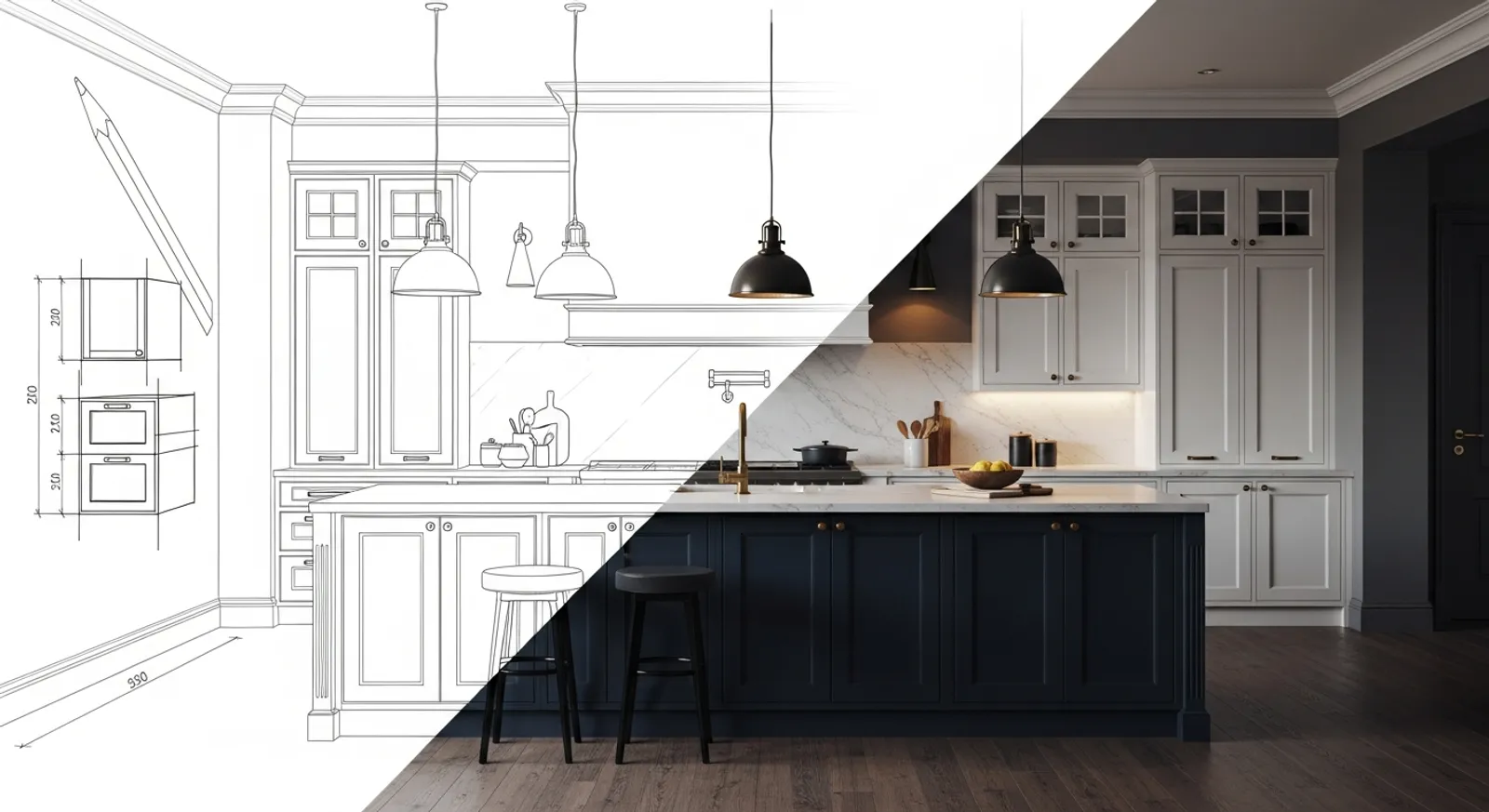
INITIAL DESIGN INTENT: The architect provides plan, elevations, and (if available) 3D references. Design intent drawings do not need to be production-detailed at this stage; the manufacturer's technical team translates intent into production geometry.
SITE MEASUREMENT VERIFICATION: KITWOOD performs site measurement before production drawings are issued. Site dimensions inevitably vary slightly from architect's drawings due to tolerance in walls, floors, and ceilings. The architect is informed of any material discrepancy so the design can be adjusted (typically through filler-panel placement or cabinet-width adjustment) before production.
PRODUCTION DRAWINGS: Issued to the architect for review and approval before manufacture. Production drawings show every cabinet, every dimension, every material specification, every hardware item. The architect's approval is the trigger for production.
REVISION CYCLES: Late revisions (after production has started) carry cost and timeline implications. Early revisions (during design development) are absorbed without issue. Late revisions are sometimes unavoidable when site conditions change or client preferences shift; KITWOOD's response is always to find the lowest-cost path back to the design intent rather than to refuse the change.
FOR MORE: See our manufacturing-vs-import guide for the broader context on why drawing-exchange flexibility matters when comparing supplier models.
Site Coordination With Other Trades
Kitchen installation requires coordination with multiple other trades. The architect typically owns this coordination through the main contractor, but kitchen-specific notes:
ELECTRICAL READINESS: Power points for built-in appliances, under-cabinet lighting circuits, and oven/hob feeds must be in the correct positions before cabinet installation. KITWOOD provides electrical drop coordinates 2–4 weeks before installation; architects pass these to the project electrician through the main contractor.
PLUMBING READINESS: Water and drainage rough-in for the sink, dishwasher, and (where applicable) ice maker or filtered water tap must be in position. Position is dimensioned in the production drawings.
FLOORING READINESS: Floor finishes should be installed before cabinet installation when the floor finish runs under the cabinet line; or after, when the cabinet line forms the perimeter. The architect's specification determines which approach applies.
WALL FINISH READINESS: Splashback area should be prepared for the chosen splashback material (tile substrate, glass mounting, stone fixing) but the splashback itself is typically installed after cabinets so it can be templated against the actual installed cabinet line.
CEILING AND COVING: For floor-to-ceiling cabinet runs, ceiling level and any coving detail must be confirmed before production. Variations of more than 5 mm require either scribing on site or production adjustment.
VENTILATION: Cooker hood ventilation route must be coordinated with the structural and HVAC drawings. KITWOOD identifies the cabinet penetration; the route through the building structure is the architect's coordination.
Project Types and Typical Approach
Different project types have different specification considerations:
HIGH-END RESIDENTIAL: Architect typically owns the design vision; client owns the budget. KITWOOD's role is to deliver the architect's design at the agreed specification within budget. Custom dimensions, custom materials, custom hardware are routine. Lead times of 8–12 weeks from approved drawings to handover.
VILLA AND PRIVATE PROJECTS: Often involve multiple cabinetry zones (main kitchen, scullery/back kitchen, butler's pantry, wardrobes throughout, bathroom vanities). KITWOOD frequently delivers all cabinetry zones from a unified material library, ensuring consistent finish across the project. See our wardrobes hub for the wardrobe scope of work.
HOSPITALITY PROJECTS: Restaurant kitchens, hotel suite kitchenettes, and serviced apartment cabinetry. Specification typically prioritises durability and standardisation over uniqueness. KITWOOD has produced cabinetry for hospitality projects including standardised unit fitouts at scale.
OFFICE AND COMMERCIAL: Office tea-points, executive kitchens, reception cabinetry, and meeting-room storage. Often integrated with broader interior architecture; specification follows the architect's millwork standard rather than residential kitchen conventions.
RENOVATION AND REFIT: Existing kitchens replaced within an existing space, often with constrained access or programme. Site measurement is critical; production drawings sometimes require multiple revision cycles to accommodate as-built site conditions discovered during demolition.
Working Relationship Notes for Architecture Firms
Practical notes from KITWOOD's experience working with Lebanese and regional architecture firms:
DIRECT TECHNICAL CONTACT: Architects work directly with KITWOOD's design and technical team rather than through a sales channel. Drawing reviews, specification questions, and revision discussions happen at the technical level.
SAMPLE LIBRARY ACCESS: Material samples (door finishes, edge treatments, worktop samples, hardware samples) available for the architect's design library or for client presentations. Samples can be sent to the architect's office or held at KITWOOD's Sin El Fil or Zouk Mosbeh showrooms for client meetings.
CLIENT MEETINGS AT KITWOOD: For projects where the client wants to see the production capability before commitment, client meetings can be hosted at the showroom or — for serious specification discussions — at the Zouk Mosbeh factory itself.
PROGRAMME ALIGNMENT: KITWOOD's standard production lead time is 8–12 weeks from drawing approval. For projects on a tight programme, this is communicated early so the architect can sequence the kitchen procurement appropriately within the broader fitout schedule.
COMMERCIAL TRANSPARENCY: Itemised pricing per cabinet, per material, per hardware item. The architect can review the cost structure and make value-engineering decisions without an opaque catalogue markup.
For architects considering KITWOOD as a manufacturing partner for an upcoming project, direct contact through our project enquiry form is the fastest way to start a technical discussion.
Frequently Asked Questions: Architects Specifying Kitchens in Lebanon
**Does KITWOOD work to architect-supplied designs?** Yes — that is the core of the business. The architect provides design intent; KITWOOD's technical team translates it into production drawings and manufactures to specification.
**Are CAD blocks and technical specifications available for the architect's design library?** Yes — material samples, technical specifications, and reference drawings are provided to the architect on request to support the design and tender stages.
**Who owns the design IP?** The architect's design is the architect's IP. KITWOOD's role is manufacturing to that design; KITWOOD does not claim design ownership of architect-supplied work.
**What is the typical lead time from approved drawings to installation?** 8–12 weeks for standard custom projects, depending on material specification and project size. Lead times are confirmed at tender stage and tracked against the architect's project programme.
**Can KITWOOD coordinate with our preferred worktop, appliance, or hardware suppliers?** Yes — when the architect's specification names specific suppliers, KITWOOD coordinates with those suppliers. KITWOOD also has established relationships with major worktop fabricators and appliance distributors in Lebanon if specification flexibility is acceptable.
**Do you provide post-installation support direct to the end client?** Yes — KITWOOD's after-sales relationship is direct with the end client (typically the homeowner), with the architect copied on any significant communication that affects the project as built.
**Can we visit the factory before specifying KITWOOD on a project?** Yes — factory visits are encouraged for architects considering KITWOOD as a manufacturing partner. The Zouk Mosbeh facility is open by appointment.
For specific project enquiries, contact KITWOOD directly or visit our kitchens hub for additional product context.
Ready to start your project?
Book a Free Consultation with KITWOOD Lebanon
Visit our showrooms in Sin el Fil (Saloumeh Roundabout) or Zouk Mosbeh (Jounieh Highway), or request a showroom consultation anywhere in Lebanon.