KITWOOD Lebanon logo — bespoke kitchen, wardrobe and interior furniture manufacturer since 1981Get in Touch
KITWOOD kitchen materials Lebanon — premium cabinet finishes and hardware systems
Kitchen Materials Guide

Kitchen Materials Lebanon

Cabinet structure, premium finishes, precision hardware, and stone worktops — every material behind a KITWOOD kitchen, chosen and tested for Lebanon's climate.

WhatsApp Us

Cabinet Structure — Base, Tall & Wall Units

Every KITWOOD kitchen is built around a three-tier cabinet system: base units, tall units, and wall units. Each serves a distinct functional role, and together they determine the ergonomics, storage capacity, and visual balance of the finished kitchen.

Base units form the worktop-level foundation of the kitchen. They carry the heaviest loads — pots, appliances, and pantry provisions — and house the drawer banks, pull-out systems, and sink integration. KITWOOD base units are constructed from 18mm moisture-resistant HDF panels with internal cross-bracing, giving them the structural rigidity to support heavy stone worktops without flex or settling over time.

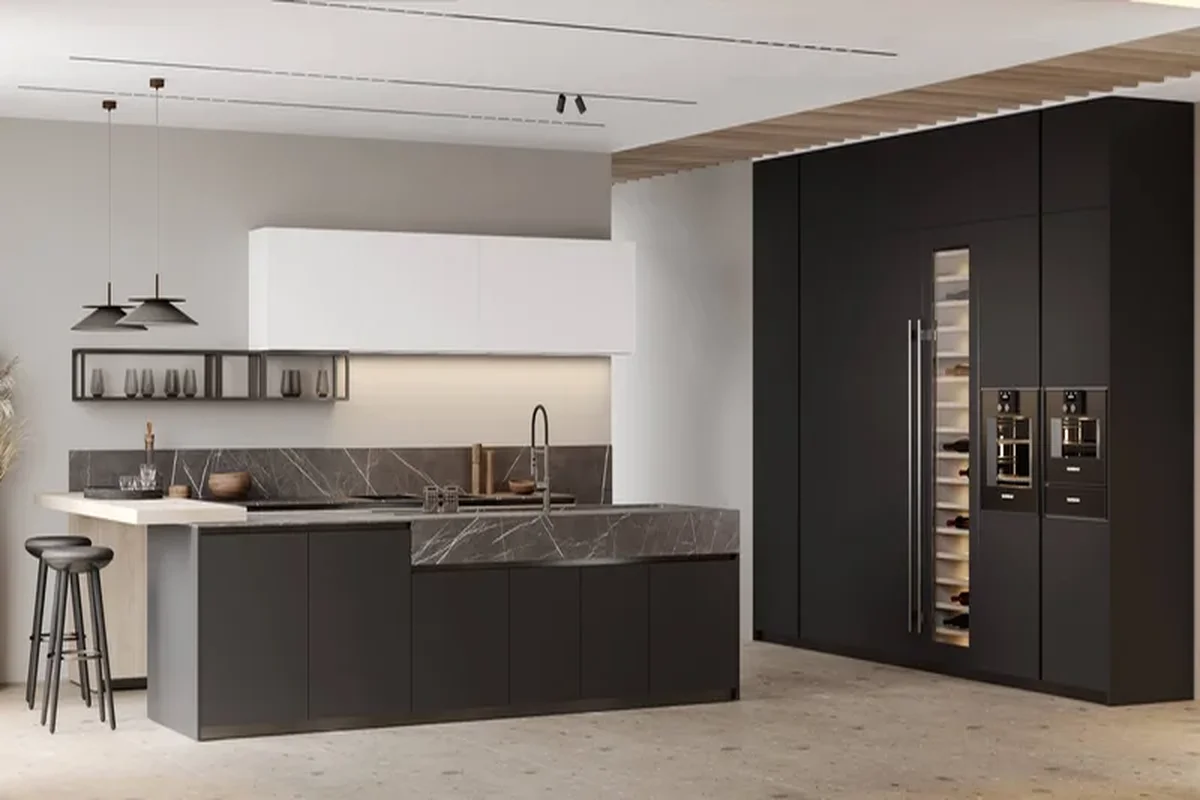
Tall units provide full floor-to-ceiling storage, typically housing integrated appliances (ovens, refrigerators, warming drawers), pull-out larder systems, and cleaning cupboards. A well-proportioned tall unit brings architectural order to the kitchen, anchoring the layout and providing visual symmetry. Our tall unit columns are built with internal reinforcement and adjustable levelling feet concealed behind matching plinths.

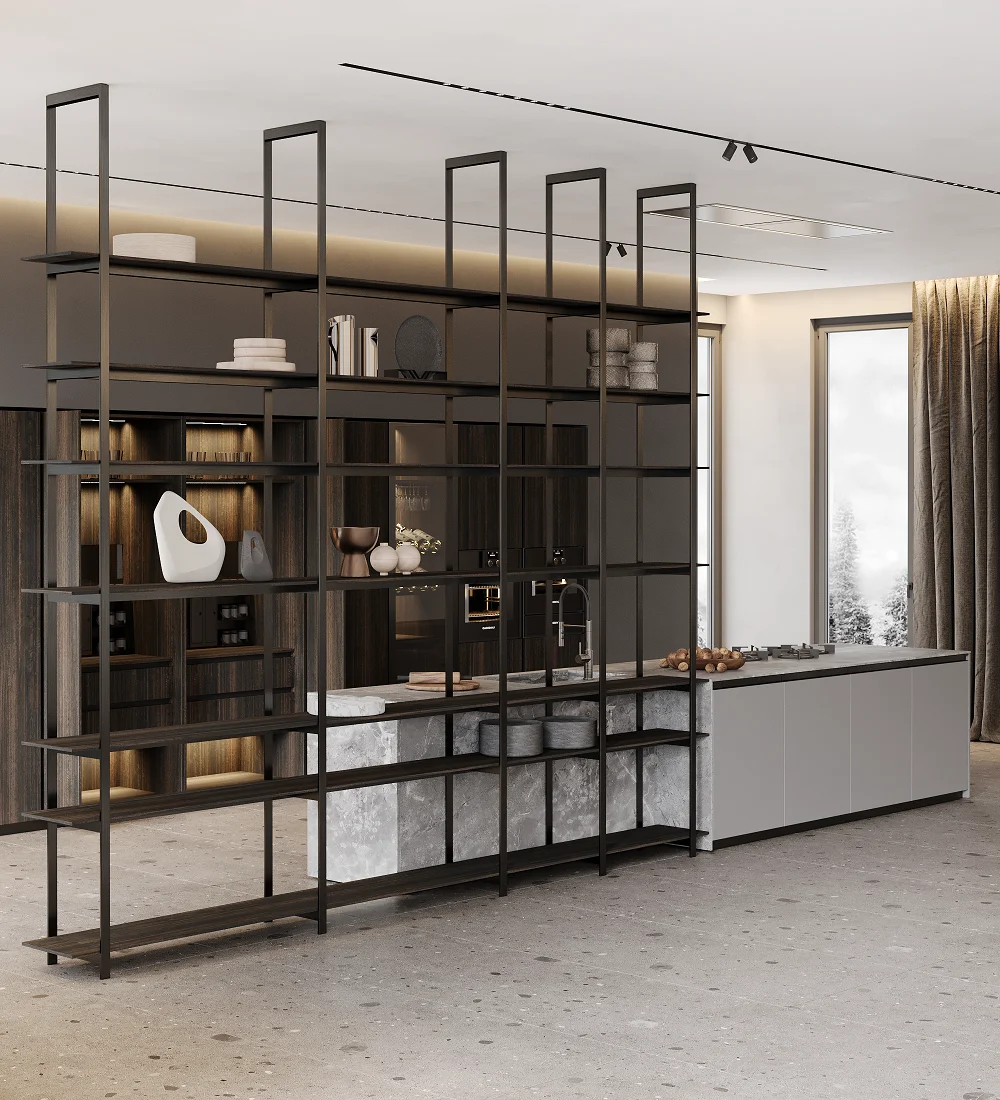
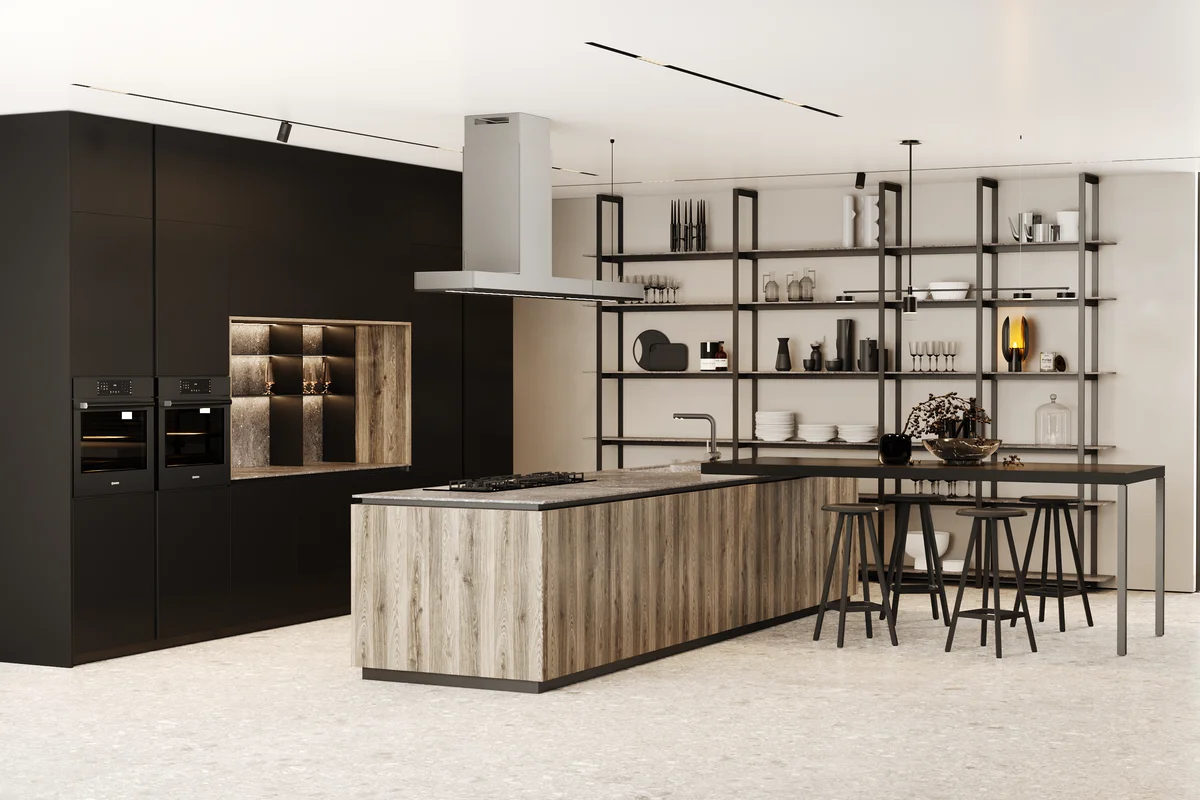
Wall units extend storage into the vertical space above the worktop without overwhelming the room. In contemporary kitchens, wall units are often reduced in depth or number to maintain openness — replaced by open shelving, integrated extractor housings, or tall units at either end. KITWOOD designs wall unit configurations that balance storage needs with the proportional requirements of each kitchen.

Door Finishes — Lacquer, Veneer, Melamine & Ceramic

The door finish defines the character of the kitchen. KITWOOD manufactures in four primary material families, each with distinct visual and practical properties suited to Lebanon's climate and lifestyle.

Lacquer is the most specified finish across our range — a spray-applied, oven-cured coating that delivers a flawless, seamless surface in any RAL or NCS colour. KITWOOD uses a multi-coat lacquer process: primer, base, and UV-resistant topcoat applied robotically in our Zouk Mosbeh facility. The result is a surface that resists moisture, heat, and impact while maintaining its depth and sheen over years of use. Both matte and gloss lacquer finishes are available across every collection.

Veneer brings the warmth and natural variation of real wood to the kitchen. KITWOOD sources veneers from sustainable FSC-certified suppliers and finishes them with professional-grade UV lacquers that protect against fading in the intense Lebanese sun. Oak, walnut, and eucalyptus are our most specified veneer species — each available in natural, stained, and fumed variants to suit the broader interior.

Melamine and HPL (High Pressure Laminate) provide a practical, cost-efficient surface for secondary cabinetry or utility areas. These finishes are thermally fused to the substrate, making them highly resistant to scratching, moisture, and everyday kitchen contact. Available in a wide range of solid colours and textured surfaces, including convincing wood-grain patterns.

Ceramic and porcelain door fronts represent the premium frontier of kitchen design. Large-format ceramic panels — the same material used for worktops — can be applied to door fronts, giving the kitchen an extraordinary material consistency. Ultra-durable, heat-resistant, and essentially impervious to moisture, ceramic door fronts are increasingly specified for exposed outdoor kitchen areas in Lebanese villas.

Hardware Systems — Blum Hinges & Drawer Technology

Hardware is the mechanical heart of the kitchen. KITWOOD specifies Blum (Austria) hardware throughout every collection — the global benchmark for precision cabinet fittings, tested to 100,000 opening cycles under laboratory conditions.

Blum CLIP top BLUMOTION hinges are fitted to every KITWOOD hinged door. These concealed hinges incorporate Blum's BLUMOTION soft-close mechanism, which cushions the door in the final 15° of closing — eliminating slamming, protecting the door and frame, and producing the satisfying, quiet close that distinguishes a premium kitchen from an ordinary one. The hinges are fully adjustable on three axes (height, depth, side) after installation, allowing our fitters to achieve perfect door alignment across the full run of cabinetry.

Blum LEGRABOX and TANDEMBOX drawer systems underpin KITWOOD's drawer-heavy contemporary collections. The LEGRABOX is Blum's premium steel-frame drawer system — with sides of just 12.8mm, it maximises internal drawer capacity while maintaining exceptional structural rigidity. BLUMOTION soft-close runners are integrated directly into the system, requiring no separate damper. The TIP-ON electronic opening (available in push-to-open configurations) is compatible with LEGRABOX across all KITWOOD handleless kitchen designs.

SERVO-DRIVE motorised lift systems from Blum are available for wall unit doors — where a motorised flap allows the cabinet to be opened at a touch and raised clear of the work surface. These are particularly practical for tall wall units above the cooking zone, where reaching up to standard hinged doors is awkward. Motion-sensor and remote-control integration is available on request.

Sinks & Water Integration

The sink is one of the most-used surfaces in the kitchen — chosen once and expected to perform perfectly for the life of the kitchen. KITWOOD integrates sink and tap systems from Blanco (Germany), whose products combine engineering precision with a design aesthetic consistent with the contemporary Lebanese kitchen.

Blanco stainless steel sinks are specified across our mid-range and premium kitchens — with deep-drawn bowls in 18/10 stainless steel that resist staining, scratching, and thermal shock. Blanco's SILGRANIT composite granite sinks offer an alternative material in anthracite, white, and warm grey — virtually impervious to scratching and heat up to 280°C, and visually distinctive in kitchens where a uniform worktop-and-sink surface is the design intention.

Undermount sink integration — where the sink is mounted beneath the worktop with no visible rim — is the default specification for all stone and engineered quartz worktops in KITWOOD kitchens. This gives a seamless, hygienic surface where water and crumbs wipe directly into the bowl, with no rim to trap debris. Flush-mount (inset) and integrated (formed from the same material as the worktop) sink options are also available depending on the worktop specification.

Tap integration: KITWOOD coordinates tap selection with the broader kitchen hardware — ensuring the tap finish (brushed steel, matte black, chrome) is consistent with door handles, appliance trim, and lighting fixtures. Filtered water taps with integrated under-sink filtration are available as a premium addition.

Worktops — Stone, Quartz & Porcelain

The worktop is the most used horizontal surface in the kitchen and the most visible material choice in the overall composition. KITWOOD fabricates and installs all stone, quartz, and porcelain worktops in-house — templating after cabinetry installation, fabricating in our workshop, and fitting by our stone team.

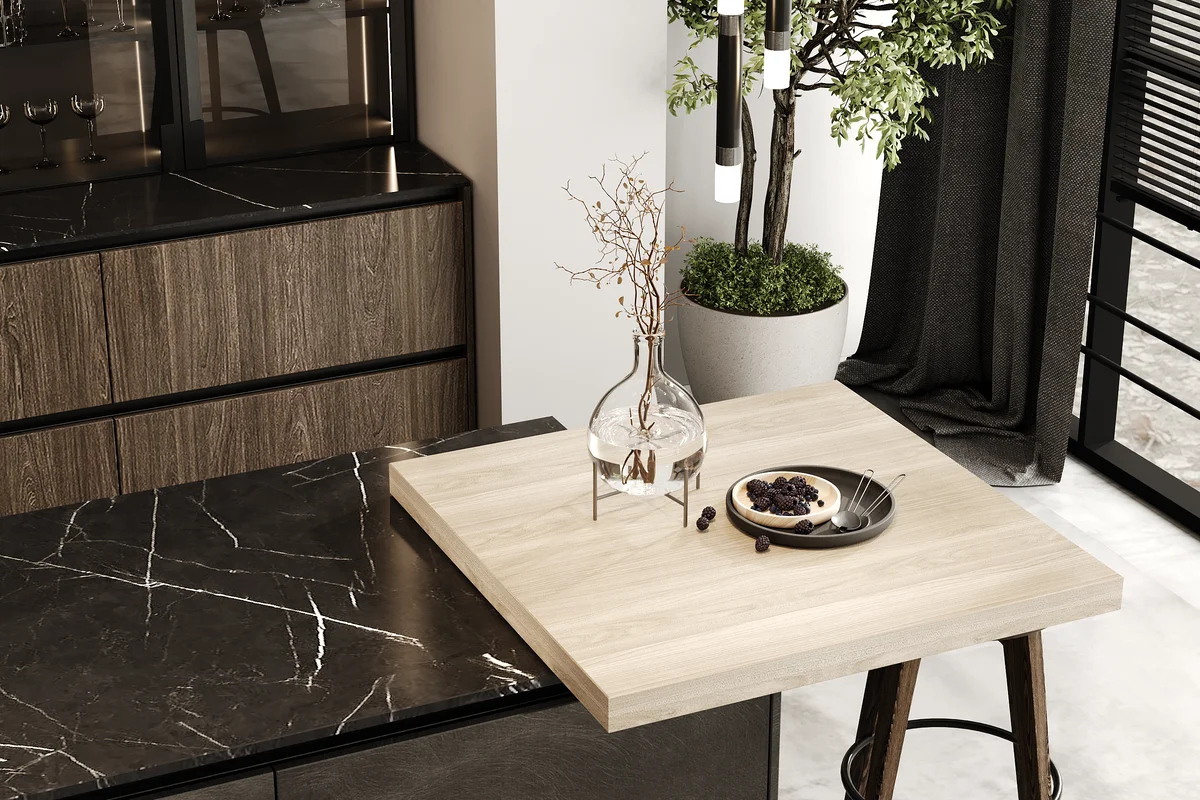
Marble — Calacatta, Statuario, and Arabescato are the most requested marble species for Lebanese kitchens. Marble's warmth and natural variation make it irreplaceable in certain interior aesthetics, but it requires sealing and careful maintenance. It is best suited to low-activity sections (island seating overhangs, cocktail areas) rather than primary cooking surfaces.

Engineered quartz composites — Silestone, Caesarstone, and premium alternatives — deliver stone's visual quality with a non-porous, low-maintenance surface. Quartz composites are the most practical high-end worktop choice for the busy Lebanese kitchen — heat-resistant, stain-resistant, and requiring no sealing.

Large-format porcelain slabs — available in thicknesses from 6mm to 20mm, in marble-effect, concrete, and monolithic colour patterns — represent the most durable and design-forward worktop category. Porcelain is UV-stable (essential for outdoor kitchens in Lebanon's climate), impervious to heat and moisture, and available in formats up to 320 × 160cm for seamless island tops.

MDF vs Plywood — Choosing the Right Substrate for Lebanon

The debate between MDF and plywood for kitchen cabinet construction is one of the most common questions in any serious kitchen consultation — and in Lebanon's market, the answer has specific climate-driven implications that manufacturers in temperate climates do not always address.

MDF (Medium Density Fibreboard) is the standard substrate for kitchen door fronts and decorative panel applications in KITWOOD kitchens. Its surface is exceptionally smooth and consistent — a prerequisite for the flawless lacquer finish that KITWOOD's premium collections are known for. MDF accepts CNC profiling cleanly, giving precise, repeatable edge detail on moulded and routed doors. However, standard MDF is moisture-absorbent: in humid coastal environments — Beirut, Jounieh, Sidon — standard MDF carcasses swell, delaminate, and ultimately fail. KITWOOD uses moisture-resistant MDF (E1 formaldehyde-rated) for all door panels, with moisture-resistant HDF for carcass components where the risk of water contact is higher.

Plywood offers a different set of properties. Its cross-laminated construction gives it dimensional stability in both directions and exceptional screw-holding strength — important for hinges, drawer runners, and structural joins that undergo repeated mechanical stress. Baltic birch plywood with a structural glue (WBP-grade, waterproof boiling proof) is the professional specification for kitchen carcasses in high-humidity environments. KITWOOD selects plywood over MDF wherever dimensional stability and screw retention are structurally critical.

The practical answer for a Lebanese kitchen: use moisture-resistant HDF or structural plywood for carcasses; use moisture-resistant MDF for door fronts and decorative panels where surface quality is the priority. The two materials serve different structural roles — neither is universally superior, but substituting one for the other in the wrong application is a specification error that reveals itself within three to five years.

Lacquer vs Laminate — A Technical Comparison for Lebanon

Lacquer and laminate are the two most common door finish categories in the Lebanese kitchen market — and they are often discussed as if they are equivalent in quality but different in price. They are not equivalent. They are fundamentally different processes with different performance profiles, and choosing between them requires an honest assessment of your priorities.

Lacquer is a multi-coat, spray-applied finish cured under UV or heat — a process that creates a chemical bond between the coating and the substrate. The result is a finish of exceptional depth, uniformity, and repairability. KITWOOD's lacquer process applies a minimum of three coats (primer, colour base, topcoat) using automotive-grade spray equipment, then cures in an oven at controlled temperature. The topcoat is UV-resistant, protecting against the colour-fading that is particularly rapid in Lebanon's intense summer sunlight. Lacquer can be colour-matched to any RAL, NCS, or Pantone reference — giving total creative freedom without any standard colour range limitation. If a lacquered door is scratched or damaged, the panel can typically be stripped and re-lacquered by a skilled finisher.

Laminate — including HPL (High Pressure Laminate) and melamine — is a thermally-fused surface: a printed paper layer impregnated with resin, pressed onto the substrate panel under high heat and pressure. The result is an exceptionally durable surface resistant to impact, scratching, and everyday moisture. Laminate finishes are thinner and harder than lacquer — they do not have the same visual depth, and the surface texture is determined by the press plate rather than the application process. However, laminate is significantly more resistant to mechanical surface abrasion — a consideration for kitchens with very young children or intensive commercial use.

For the premium Lebanese home kitchen, lacquer remains the most specified finish — offering the visual quality that laminate cannot replicate, combined with colour freedom and a surface that improves the perceived value of the entire kitchen. Laminate is correctly specified for secondary utility areas, rental properties, or budgets where the premium cost of lacquer is not justified.

Humidity Resistance in Lebanon's Climate — What It Means for Your Kitchen

Lebanon's climate presents a specific set of challenges that kitchen manufacturers in Europe or North America do not need to account for. The combination of coastal summer humidity (relative humidity regularly above 70–80% in Beirut and coastal cities), wet winters with temperature fluctuations, and extreme summer heat creates a stress profile that poor material specification does not survive.

The most common failure mode in Lebanese kitchens is swelling and delamination of the cabinet carcass. Standard particleboard — which is used by the majority of budget kitchen manufacturers globally — contains a paper-impregnated surface veneer and a particle core bonded with standard (non-moisture-resistant) urea formaldehyde resin. When exposed to sustained high humidity, the core swells, the surface delamination begins, and the structural integrity of the cabinet is compromised. This is a predictable outcome, not bad luck. KITWOOD uses only moisture-resistant HDF (High Density Fibreboard, E1 rated) or WBP-grade structural plywood for all carcass construction — materials whose internal binders are specifically formulated to resist humidity penetration.

Door finishes face a different set of challenges. Thermofoil (PVC wrap) finishes — common in the lower segment — delaminate at the door corners and edges when exposed to heat and humidity simultaneously, a failure mode that typically appears within two to four years in Beirut's summer conditions. Acrylic high-gloss panels, while visually striking, are more susceptible to thermal expansion than lacquer — producing visible movement at door joints in unventilated kitchens. Lacquer, applied and cured correctly, is the most stable door finish in Lebanon's climate: it bonds chemically to the substrate, tolerates thermal movement without cracking, and does not delaminate.

The sink and dishwasher zone is the highest-risk humidity area in any kitchen. KITWOOD specifies plumbing-zone cabinetry with additional internal sealing on all cut edges — reducing the capillary absorption that is the primary cause of carcass swelling under the sink. The under-sink cabinet is replaced more frequently than any other kitchen element in Lebanon; correct specification eliminates this as a maintenance concern.

Cabinet Lifespan — What to Expect from a KITWOOD Kitchen

A common question in any kitchen consultation is: how long will it last? The honest answer depends entirely on the material specification, the manufacturing quality, and the installation conditions — not on any blanket guarantee. Understanding what determines kitchen longevity gives you a realistic basis for comparison.

The carcass is the structural skeleton of the kitchen. A correctly specified moisture-resistant carcass — 18mm HDF with sealed edges, properly levelled on adjustable feet — has a functional lifespan of 25 to 30 years under normal residential use. The carcass is rarely the failure point in a premium kitchen; it is the decorative and mechanical components that determine the practical life of the installation.

Door finishes are the first visible indicator of kitchen age. Lacquer finishes, applied with proper UV-resistant topcoats, maintain their appearance for 15 to 20 years before any fading or wear becomes apparent in normal use. Veneer finishes age gracefully — the natural variation in wood grain accommodates minor surface wear without looking degraded. Laminate and HPL surfaces resist scratching but show chips at edges over time; the overall visual life is typically 10 to 15 years.

Hardware is the mechanical heart of the kitchen and the element most clearly tied to specification quality. Blum CLIP top BLUMOTION hinges are rated to 100,000 opening cycles under laboratory conditions — at 20 openings per day, that is 13 years of use to the test limit, with performance in practical conditions often extending well beyond. The key advantage of premium hardware is adjustability: Blum hinges and drawer runners are adjustable in three dimensions after installation, meaning that as a building settles and door alignment shifts, the hardware can be recalibrated rather than replaced.

The most honest lifespan guidance for a KITWOOD kitchen with correct material specification: a minimum of 15 to 20 years of full performance, with the carcass structure remaining sound for 25 to 30 years. Individual components — door finishes, worktops, hardware — can be updated independently as trends change or wear accumulates, without replacing the entire kitchen.

Maintenance Considerations for Lebanese Kitchen Materials

The best kitchen material is one that performs without requiring constant intervention. Understanding the maintenance requirements of each material choice at the specification stage prevents surprises after installation.

Lacquer surfaces are low maintenance by design. The cured multi-coat lacquer forms a sealed, non-porous surface: everyday cleaning requires only a soft damp cloth and a mild neutral detergent. Abrasive cleaners, bleach-based products, and high-alkaline degreasers should be avoided — they attack the topcoat over time and dull the finish. For matte lacquer in particular, microfibre cloths produce better results than paper or cotton, which can leave micro-scratches visible in raking light.

Stone and engineered quartz worktops: marble requires sealing twice a year with a penetrating stone sealer to prevent staining from acidic liquids (lemon, wine, vinegar). Engineered quartz requires no sealing — its non-porous structure makes it the most maintenance-free worktop choice for the primary preparation surface. Large-format porcelain requires only standard tile cleaning and is impervious to acids and staining.

Blum hardware maintenance is minimal by design. The BLUMOTION soft-close mechanism requires no lubrication or adjustment for the first several years of use. If door alignment shifts — typically after a building settles or humidity cycles cause minor dimensional movement in door panels — KITWOOD's three-axis Blum hinges can be adjusted with a Phillips screwdriver without removing the door. This is a five-minute procedure that restores perfect door alignment and is a standard part of KITWOOD's post-installation support.

Sink zones: under-sink cabinets should be inspected annually for any signs of moisture ingress, particularly around plumbing penetrations and base panel edges. If minor swelling is caught early, the penetration can be re-sealed and the damaged panel section replaced without full cabinet removal. Ignoring early signs of under-sink moisture is the most common cause of progressive kitchen damage in Lebanon.

See our detailed guide to kitchen accessories and internal storage systems at the kitchen accessories page for information on maintaining pull-out systems, drawer runners, and corner storage mechanisms.

For detailed guidance on the internal organisation systems, pull-out accessories, hinge mechanisms, and storage solutions specified in every KITWOOD kitchen, see our kitchen accessories and mechanism guide. For worktop materials — stone, quartz, and porcelain — see our countertops Lebanon page.

At a Glance

Carcasses18mm moisture-resistant HDF
HardwareBlum (Austria) throughout
FinishesLacquer, veneer, melamine, ceramic
WorktopsMarble, quartz, porcelain
SinksBlanco stainless & SILGRANIT
ConsultationFree showroom consultation

FAQ

Kitchen Materials — Common Questions

Get Started

Ready to Start Your
Custom Kitchen?

Visit our showroom to explore the full material range in person, or contact us by email or social media to start your project. No obligation.

Custom Kitchens in Lebanon